Treatment-resistant anxiety, panic attacks
Thyroid autoimmunity
TPO Antibodies: 847 IU/mL (normal <35)
Routing question: does thyroid evaluation need to run alongside psychiatric care before another medication trial?
DIAGNOSTIC PSYCHIATRY
A clinical evaluation framework for psychiatric symptoms that don't fit, don't respond, or keep returning. The largest US trial of stepwise psychiatric medication found only about one in three patients reach remission after their first trial — and many non-responders have unaddressed medical contributors that standard workups don't investigate.
STAR*D, Trivedi et al., Am J Psychiatry 2006.
patients reach remission after their first psychiatric medication trial.
The remaining two-thirds either partially respond, switch medications, or stop treatment. Some non-responders have unaddressed medical contributors — thyroid dysfunction, iron status, B12, sleep apnea, autoimmune thyroiditis, parathyroid disease, and others — that standard psychiatric workup does not routinely investigate.
STAR*D, Trivedi et al., Am J Psychiatry 2006.
Diagnostic Psychiatry is a clinical evaluation framework, not a brand of medicine. When psychiatric symptoms don't fit, don't respond, or keep returning, the diagnostic question should re-open before another medication trial. The differential stays wide until the pattern actually fits.
Start with the condition pages and the framework sections. Use them to ask better questions of whoever is treating you.
See conditions → For cliniciansAdopt the methodology, do a referral check, or review the evidence. The methodology, evidence, and protocol depth is where the work lives.
See methodology →Authored by Canybec Sulayman, PMHNP, AGPCNP. Applied clinically at Horizon Peak Health. The methodology is open — any clinician can adopt the same diagnostic discipline.
01
The problem
clinical inputs organized
routing outcomes named
single-lab diagnoses
A standard psychiatric intake is narrow by design. A symptom-triggered review asks what medical, sleep, medication, and nutritional contributors should stay in the differential before the pattern is narrowed too early.
Standard care for chronic fatigue checks 2 tests. This framework reviews 9 when the history and presentation support an expanded differential.
01.4 · Reference range context
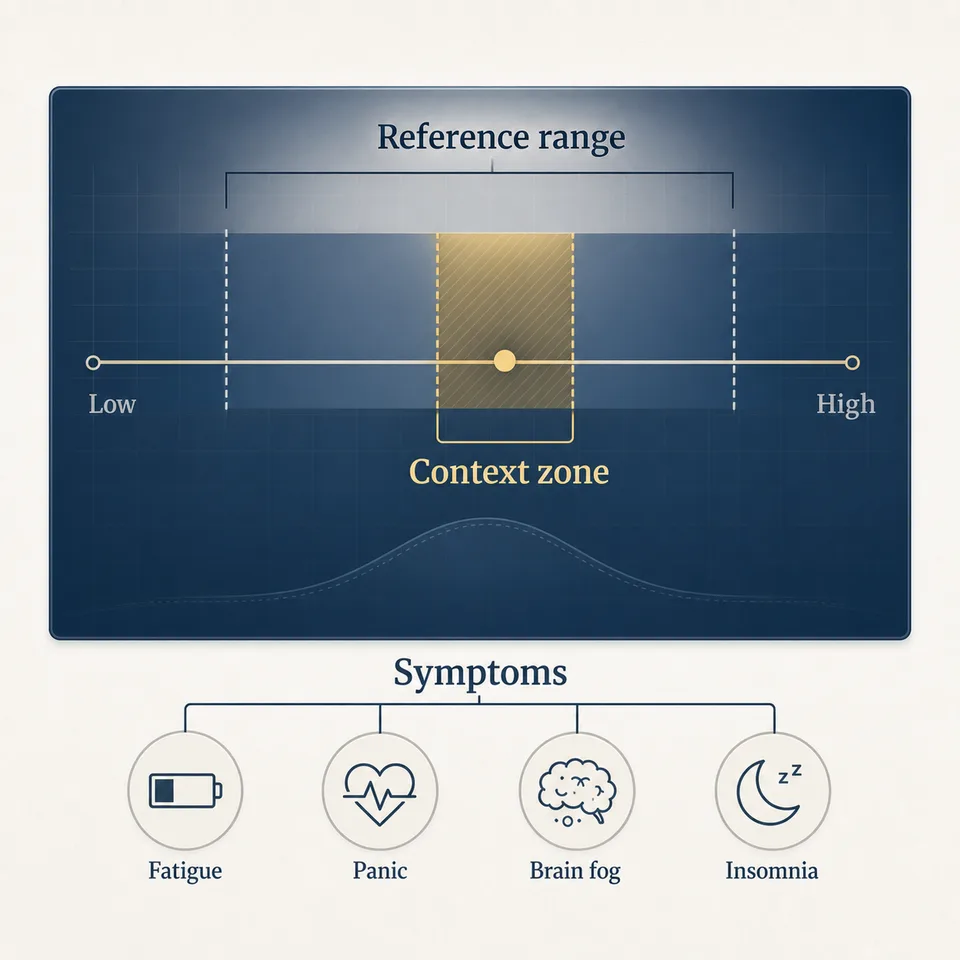
Reference ranges describe a population, not a person. When symptoms are present, a value near the edge of normal is still a signal to interpret, not a closed question.
Drag the slider to explore different values
Built from population data to flag overt thyroid disease. A value inside this band can still belong in the differential when symptoms point there.
A tighter band sometimes used in symptomatic interpretation. It is a reason to look more carefully, not a target everyone needs to hit.
02
The method
The review does not treat a lab value as the answer. It asks whether thyroid status, iron stores, sleep oxygen, B12, medications, substances, and timeline make the psychiatric differential wider or narrower.
These are inputs, not answers. A thyroid value does not diagnose anxiety. A PHQ-9 score does not rule out a medical contributor. The review reads labs beside symptoms beside medications beside sleep, then decides what belongs in the differential.
Pattern lens
The useful work happens when labs are read beside symptoms, medication timing, sleep, substances, and the timeline.
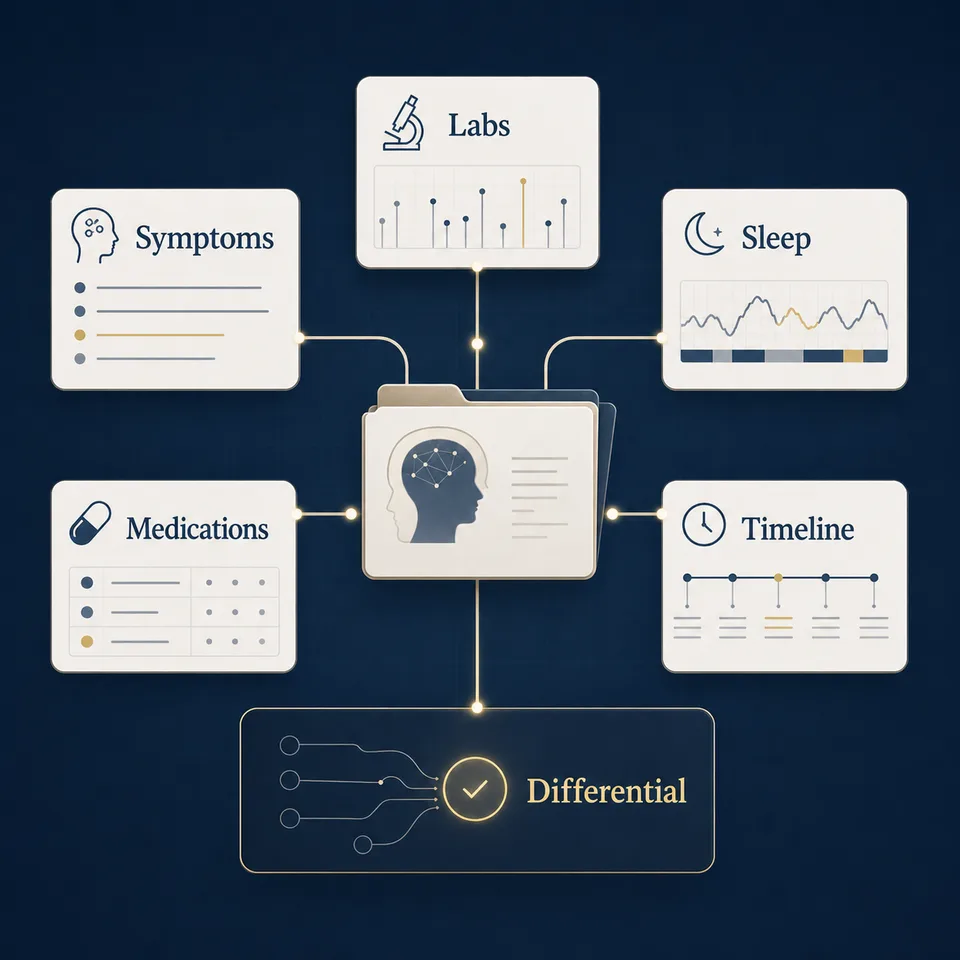
Labs, symptom timeline, medication trials, sleep pattern, supplements, substance use, PHQ-9, and GAD-7 scores are pulled into one clinical record.
TSH gets read beside fatigue and weight change. Ferritin beside focus. B12 beside cognition. The diagnostic work happens in the overlay.
What looks psychiatric may also involve sleep apnea, hypothyroidism, a medication effect, a nutritional deficit, or a combination.
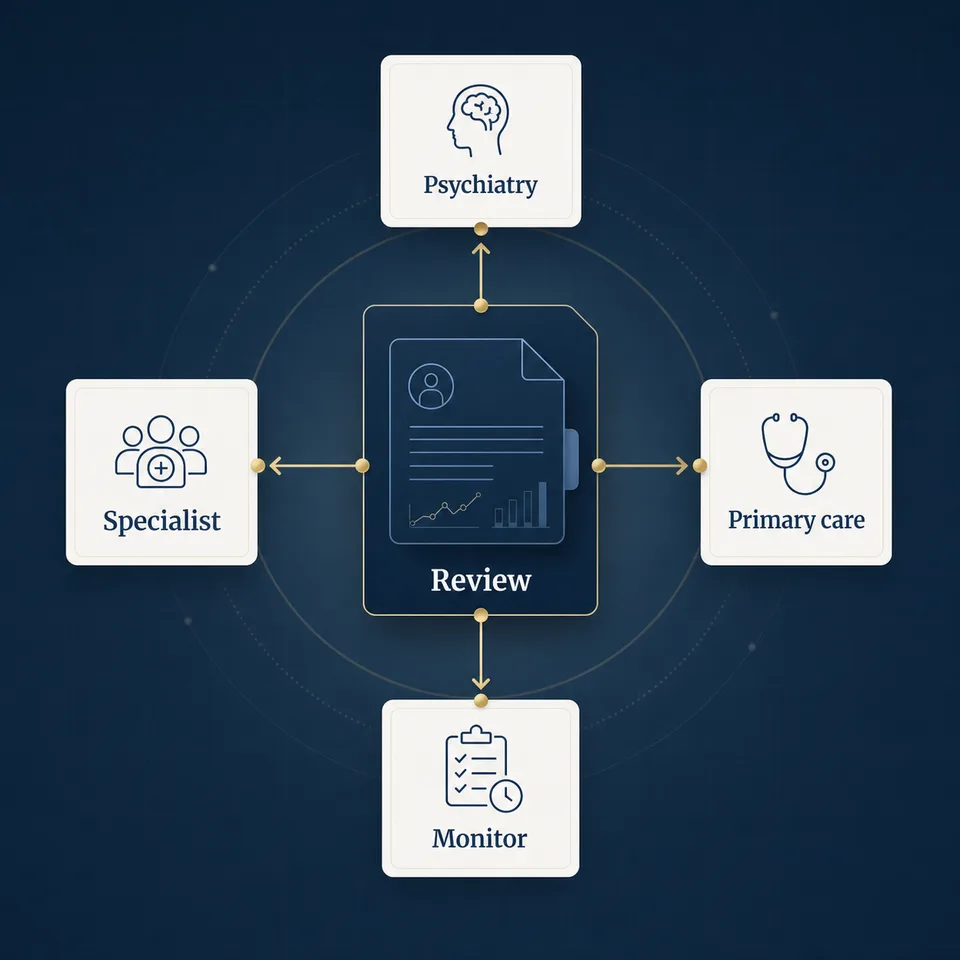
Each finding gets a pathway: further testing, referral, continued psychiatric care, monitoring, or no medical action.
02.5 · Route the finding
A finding may support ongoing psychiatric care, require primary-care follow-up, need specialty review, or simply be monitored. The point is to name the route without turning every signal into a diagnosis.
03
The pattern surface
Each page reads the symptom-condition overlap, the standard-of-care gap, the laboratory workup, and the clinical evidence. Lab values, statistics, and citations are anchored to peer-reviewed sources.
Thyroid autoantibodies can drive depression and anxiety even when TSH is in range. The standard screen often misses the antibody signal.
Read the differential → EndocrinePsychiatric symptoms often precede stones, bones, and groans by years. AAES uniquely recognizes neuropsychiatric symptoms as a surgical indication.
Read the differential → NutritionalFerritin can be clinically relevant before anemia appears. The space between <15 ng/mL deficiency and the <75 ng/mL symptomatic threshold matters.
Read the differential → NutritionalDepression, cognitive decline, and even hallucinations can appear before obvious anemia. MMA may be elevated while serum B12 still looks "normal."
Read the differential → NutritionalVitamin D status may belong in the differential when symptoms and risk factors fit, but it does not replace a full clinical workup.
Read the differential → EndocrineTSH alone misses subclinical and conversion-related thyroid dysfunction. Up to 20% of treatment-resistant depression cases have a thyroid contributor.
Read the differential →Illustrative composites, not patient stories. Each pattern shows the original psychiatric frame, the medical signal that should stay in the differential, and the routing question that follows.
TPO Antibodies: 847 IU/mL (normal <35)
Routing question: does thyroid evaluation need to run alongside psychiatric care before another medication trial?
Ferritin: 12 ng/mL (low iron stores)
Routing question: should iron status, source of deficiency, and primary care follow-up be addressed before further stimulant escalation?
TSH: 4.2 mIU/L, Free T3: low
Routing question: should thyroid status be reassessed before the case is treated as purely treatment-resistant depression?
See how antidepressants affect metabolism →Composites are illustrative of diagnostic patterns drawn from peer-reviewed literature on medical mimics in psychiatry. They are not testimonials, not specific patient stories, and not predictive of any individual response.
04
The boundary
It is not lab optimization. It is not single-cause certainty. It is not anti-psychiatry. Antidepressants, mood stabilizers, stimulants, and psychotherapy can be legitimate endpoints of a careful workup. The job is to interpret labs, symptoms, sleep, medications, and history together, including cases where no medical change is needed.
Diagnostic Psychiatry separates established medical mimics from supported associations, proposed framework concepts, and early mechanisms. That keeps the differential wide without turning every lab value into an answer.
Strong guideline, replicated review, or clear disease mechanism. Still interpreted in context.
Good evidence and clinical plausibility, but not definitive for every patient or setting.
Framework-level reasoning or emerging mechanism. Useful for the differential, not proof.
Too early for patient-facing action unless it is clearly labeled and bounded.
04.3 · Who it is for
Red marks, borderline values, or normal results are sitting next to mood, focus, sleep, energy, or anxiety symptoms without a clear interpretation.
Work, family, and responsibilities are still moving, but your clarity, stamina, motivation, or resilience feels meaningfully different.
Medication trials, therapy, screening scores, or prior diagnoses helped define severity, but did not explain what may be driving the whole presentation.
04.4 · Visual workup
Symptoms, labs, sleep, medications, and timeline are placed into one frame so the output can separate psychiatric care, medical follow-up, specialty referral, and monitoring.
05
Next step
Tools on this site surface patterns to discuss with a provider. They do not diagnose, prescribe, or replace clinical judgment.
Compare weight, cardiovascular, and liver-enzyme signals for common antidepressants using published evidence summarized for provider discussion.
Lab-pattern explainers, symptom-to-system maps, and medication review aids are in development under the tool credibility rubric.