For clinicians
A structured framework for psychiatric-medical differential diagnosis.
Diagnostic Psychiatry is not anti-psychiatry. It is a way to keep medical contributors, medication effects, sleep, and psychiatric illness in the same clinical frame.
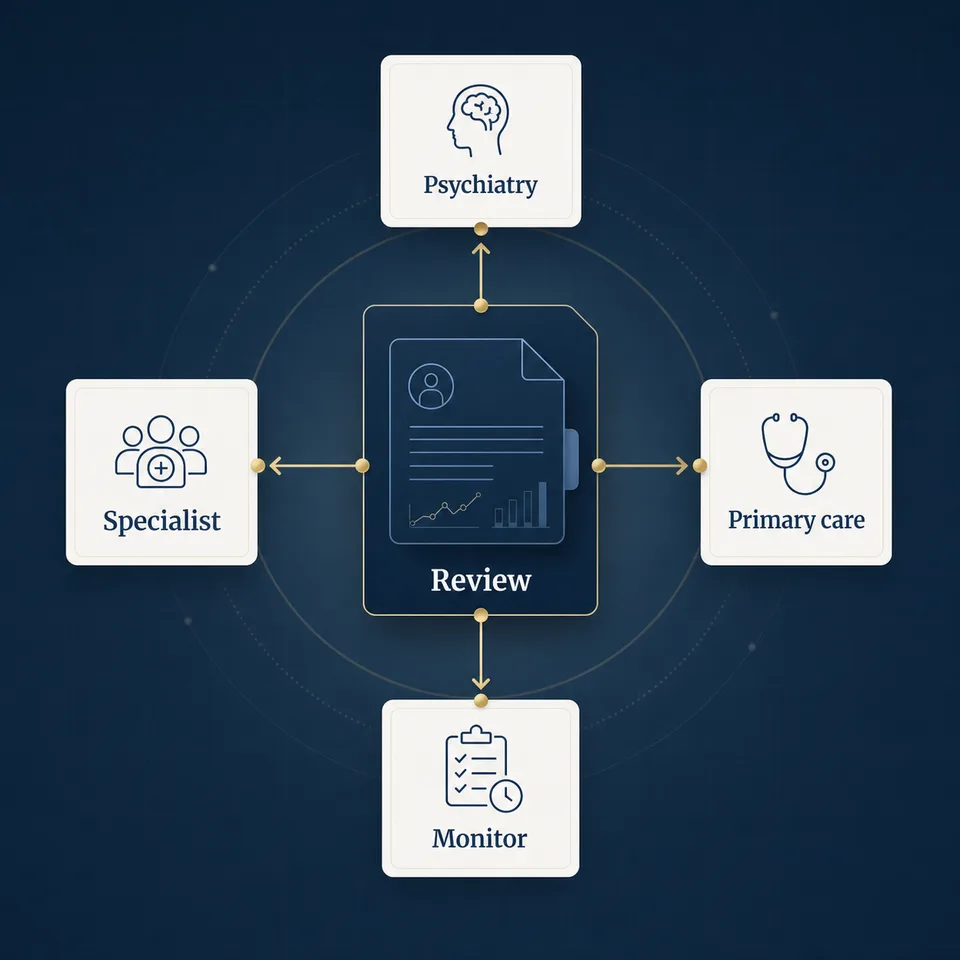
Visual frame
The deliverable is routing clarity.
The review is useful only if it separates psychiatric care, primary care follow-up, medical specialist referral, monitoring, and no-action findings without overstating what the available data proves.
Review frame
What the referral review organizes
Inputs
- Labs
- PHQ-9 and GAD-7
- Insomnia screen
- Medication and supplement list
- Sleep, caffeine, alcohol, and substance pattern
- Symptom timeline
- Top goals
Output
- Symptom and timeline summary
- Lab-pattern read in psychiatric context
- Medication, supplement, sleep, and substance review
- Psychiatric-medical differential
- Named pathway for care or monitoring
Not this
- Not emergency care
- Not a diagnosis from labs
- Not a medication or supplement change by website
- Not a replacement for primary care, psychiatry, or therapy
- Not proof that biology explains every symptom
Referral fit
Useful when the psychiatric question is bigger than a symptom score.
- Persistent depression, anxiety, insomnia, fatigue, brain fog, ADHD-like symptoms, or medication burden despite reasonable standard care.
- Lab findings, medical symptoms, sleep risk, endocrine symptoms, or medication effects that have not been integrated into the psychiatric formulation.
- A patient has extensive outside testing but needs psychiatric-medical interpretation rather than a supplement protocol.
- The treating clinician wants a clearer differential and routing language.
Output
The review should make documentation easier, not noisier.
One readable clinical frame
Symptoms, timeline, medication trials, labs, sleep, substances, and screening scores are summarized together.
Likelihood and uncertainty named
The write-up separates plausible contributors, weaker signals, missing data, and findings that should not drive care.
Next lane stated plainly
Psychiatric care, primary care, specialist evaluation, further testing, monitoring, or no medical action are distinguished.
Safety boundary
The review does not turn signals into certainty.
- The review does not replace the treating clinician.
- Medication changes, controlled substances, emergency care, and specialty treatment remain with the appropriate clinician and setting.
- Labs are signals, not diagnoses.
- This does not replace primary care, emergency care, psychiatric care, or therapy.
- Medication and supplement changes require clinician guidance.
- Urgent findings belong with the appropriate medical or emergency pathway.
- Sometimes the honest conclusion is that no medical change is needed.
Common questions
Questions people ask before they start.
Can clinical records diagnose the problem?
No. Clinical records can change what belongs in the differential. A responsible review still requires clinical history, symptoms, timing, medication context, risk review, and the appropriate clinician relationship.
What does the review actually give me?
A written psychiatric-medical synthesis: what appears more likely, what remains possible, what seems less likely, what needs another clinician, and what should be monitored or left alone.
Is this emergency care?
No. If symptoms are acute, dangerous, rapidly worsening, or involve possible self-harm, psychosis, mania, delirium, withdrawal, chest pain, neurologic symptoms, or medical instability, use emergency or urgent care.