For professionals
You can still perform and know something is off.
For founders, executives, clinicians, attorneys, engineers, and other cognitively demanding workers who need mood, focus, energy, sleep, stress tolerance, and medication context reviewed with medical discipline.
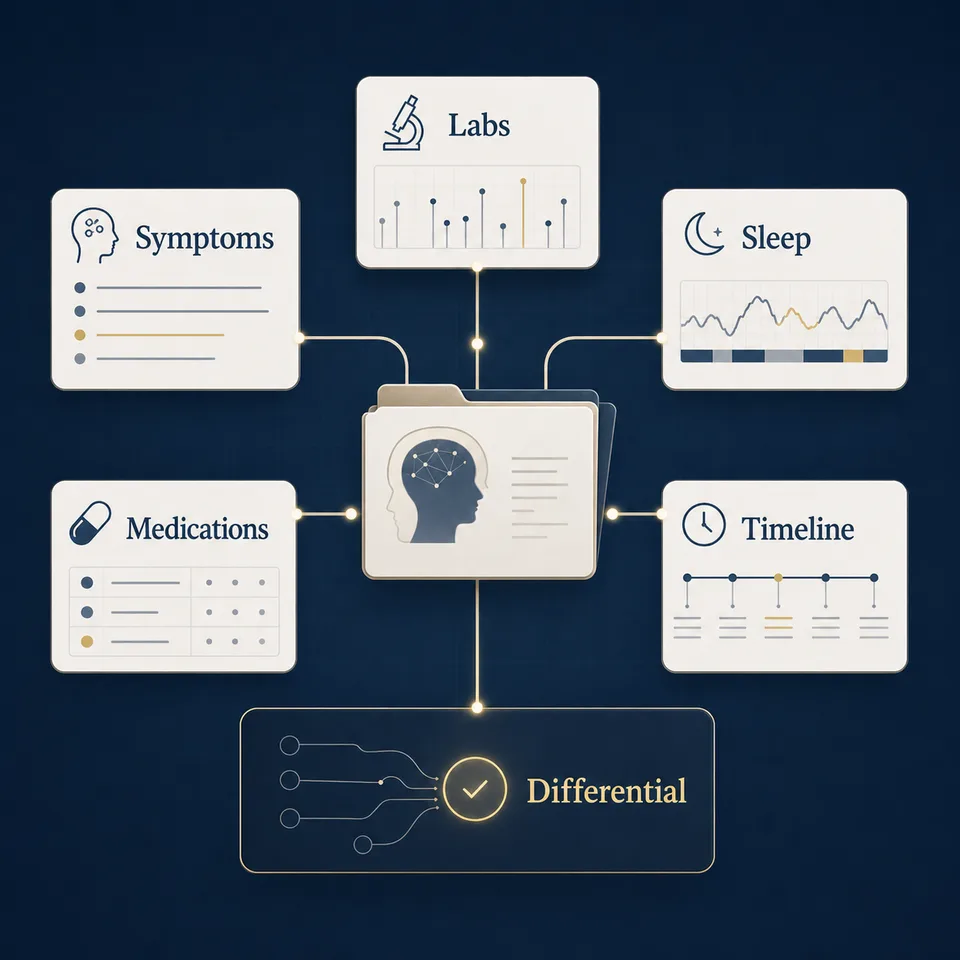
Visual frame
Performance problems are rarely one-variable problems.
For high-functioning adults, the question is often not whether they can keep going. It is why focus, sleep, energy, mood, or stress tolerance changed and what should stay in the differential.
Review frame
What professional performance review organizes
Inputs
- Labs
- PHQ-9 and GAD-7
- Insomnia screen
- Medication and supplement list
- Sleep, caffeine, alcohol, and substance pattern
- Symptom timeline
- Top goals
Output
- Symptom and timeline summary
- Lab-pattern read in psychiatric context
- Medication, supplement, sleep, and substance review
- Psychiatric-medical differential
- Named pathway for care or monitoring
Not this
- Not emergency care
- Not a diagnosis from labs
- Not a medication or supplement change by website
- Not a replacement for primary care, psychiatry, or therapy
- Not proof that biology explains every symptom
Pattern
High function can hide a real clinical signal.
People who perform under pressure can compensate for a long time. That does not make the change imaginary, and it does not make the answer motivational. The review keeps psychiatric, medical, sleep, medication, substance, and stress-context explanations in one frame.
What gets reviewed
The review looks at the variables that make a sharp person feel less sharp.
Rest that does not restore
Sleep duration, insomnia, apnea risk, circadian drift, alcohol, caffeine, stimulants, and recovery margin are read beside mood and cognition.
Signals that can mimic underperformance
Thyroid, iron, B12, glucose, inflammation, hormones, and medication effects can contribute to fatigue, brain fog, anxiety, or low drive when the pattern fits.
Psychiatry stays in the room
Depression, anxiety, ADHD-like symptoms, trauma physiology, insomnia, and burnout are considered without reducing the case to one lab or one label.
Safety boundary
The review does not turn signals into certainty.
- This is not a performance enhancement promise.
- The review does not prescribe stimulants, hormones, supplements, or medication changes from a webpage.
- Labs are signals, not diagnoses.
- This does not replace primary care, emergency care, psychiatric care, or therapy.
- Medication and supplement changes require clinician guidance.
- Urgent findings belong with the appropriate medical or emergency pathway.
- Sometimes the honest conclusion is that no medical change is needed.
Common questions
Questions people ask before they start.
Can performance signals diagnose the problem?
No. Performance signals can change what belongs in the differential. A responsible review still requires clinical history, symptoms, timing, medication context, risk review, and the appropriate clinician relationship.
What does the review actually give me?
A written psychiatric-medical synthesis: what appears more likely, what remains possible, what seems less likely, what needs another clinician, and what should be monitored or left alone.
Is this emergency care?
No. If symptoms are acute, dangerous, rapidly worsening, or involve possible self-harm, psychosis, mania, delirium, withdrawal, chest pain, neurologic symptoms, or medical instability, use emergency or urgent care.