After your labs
Your lab report is data. It is not the differential.
A lab report can tell you what is high, low, flagged, or normal. It cannot tell you by itself what belongs in the psychiatric-medical differential for mood, focus, sleep, anxiety, fatigue, or medication response.
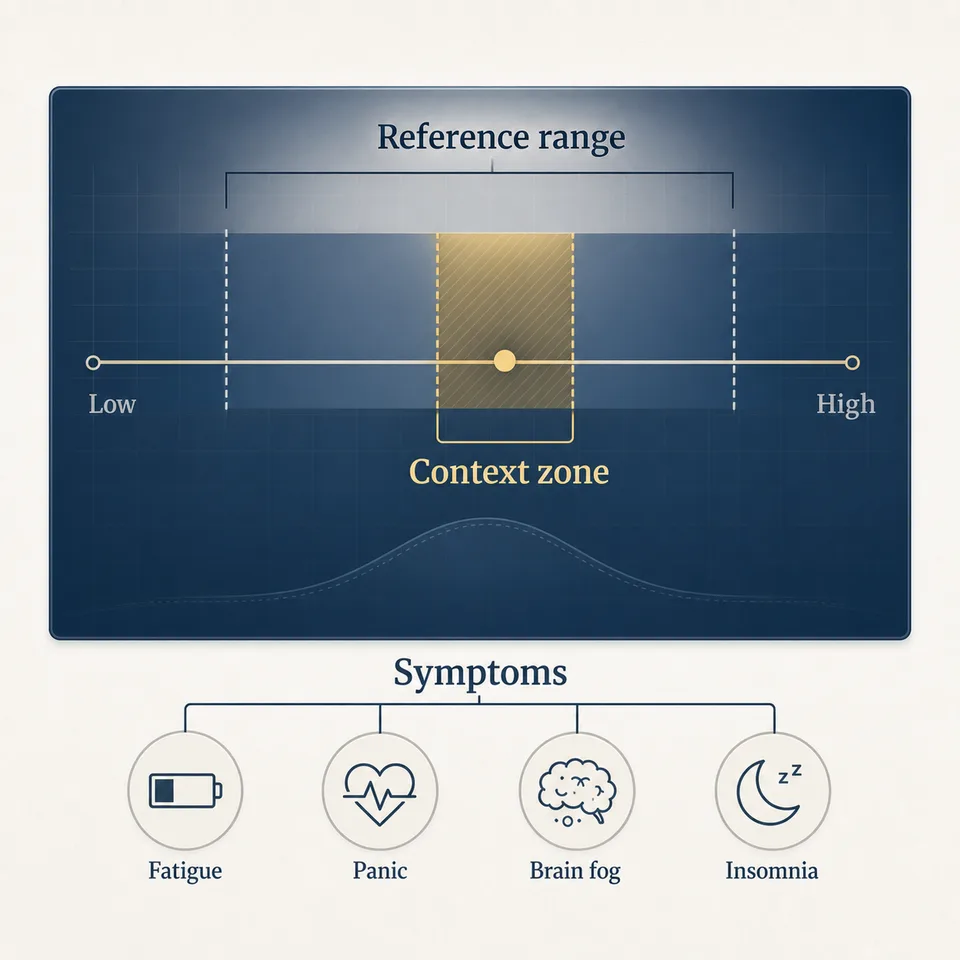
Visual frame
The useful question comes after the reference range.
Red, normal, and borderline values only become clinically useful when they are read beside symptoms, medications, sleep, menstrual or hormonal context, substances, and the timeline.
Review frame
How the lab review is structured
Inputs
- Labs
- PHQ-9 and GAD-7
- Insomnia screen
- Medication and supplement list
- Sleep, caffeine, alcohol, and substance pattern
- Symptom timeline
- Top goals
Output
- Symptom and timeline summary
- Lab-pattern read in psychiatric context
- Medication, supplement, sleep, and substance review
- Psychiatric-medical differential
- Named pathway for care or monitoring
Not this
- Not emergency care
- Not a diagnosis from labs
- Not a medication or supplement change by website
- Not a replacement for primary care, psychiatry, or therapy
- Not proof that biology explains every symptom
Lab context
Red, normal, and borderline are not clinical conclusions.
A flagged value may be noise. A value inside the reference range may still matter when symptoms fit. The clinical question is not whether the report looks clean. The question is whether the pattern explains enough.
Three reads
The same lab can mean different things in different psychiatric stories.
Flagged values need triage, not panic
Some abnormalities need prompt primary care or specialist follow-up. Others are mild, transient, or unrelated to the psychiatric presentation.
Normal can still be incomplete
A clean report may not include the markers that match fatigue, brain fog, panic, insomnia, medication effects, or endocrine symptoms.
Borderline values are pattern questions
A borderline value becomes more or less important when it is read with symptoms, trend, risk, medication history, and timing.
What changes the read
Symptoms decide whether a lab belongs in the psychiatric-medical differential.
- Fatigue and low stamina change how iron, thyroid, B12, glucose, and sleep risk are interpreted.
- Panic, tremor, heat intolerance, weight change, stimulant load, and caffeine pattern change the thyroid and medication read.
- Brain fog and poor focus change the weight given to sleep, ferritin, B12/MMA, glucose, inflammation, substances, and medication timing.
- The result can be referral, further testing, monitoring, psychiatric care, or no medical action.
Common questions
Questions people ask before they start.
Can lab results diagnose the problem?
No. Lab results can change what belongs in the differential. A responsible review still requires clinical history, symptoms, timing, medication context, risk review, and the appropriate clinician relationship.
What does the review actually give me?
A written psychiatric-medical synthesis: what appears more likely, what remains possible, what seems less likely, what needs another clinician, and what should be monitored or left alone.
Is this emergency care?
No. If symptoms are acute, dangerous, rapidly worsening, or involve possible self-harm, psychosis, mania, delirium, withdrawal, chest pain, neurologic symptoms, or medical instability, use emergency or urgent care.