Beyond symptom scores
PHQ-9 and GAD-7 measure severity. They do not finish the differential.
Screening scores are useful. They can track symptom burden and treatment response. But a score cannot explain whether sleep, thyroid, iron, B12, medications, substances, inflammation, hormones, or primary psychiatric illness is driving the pattern.
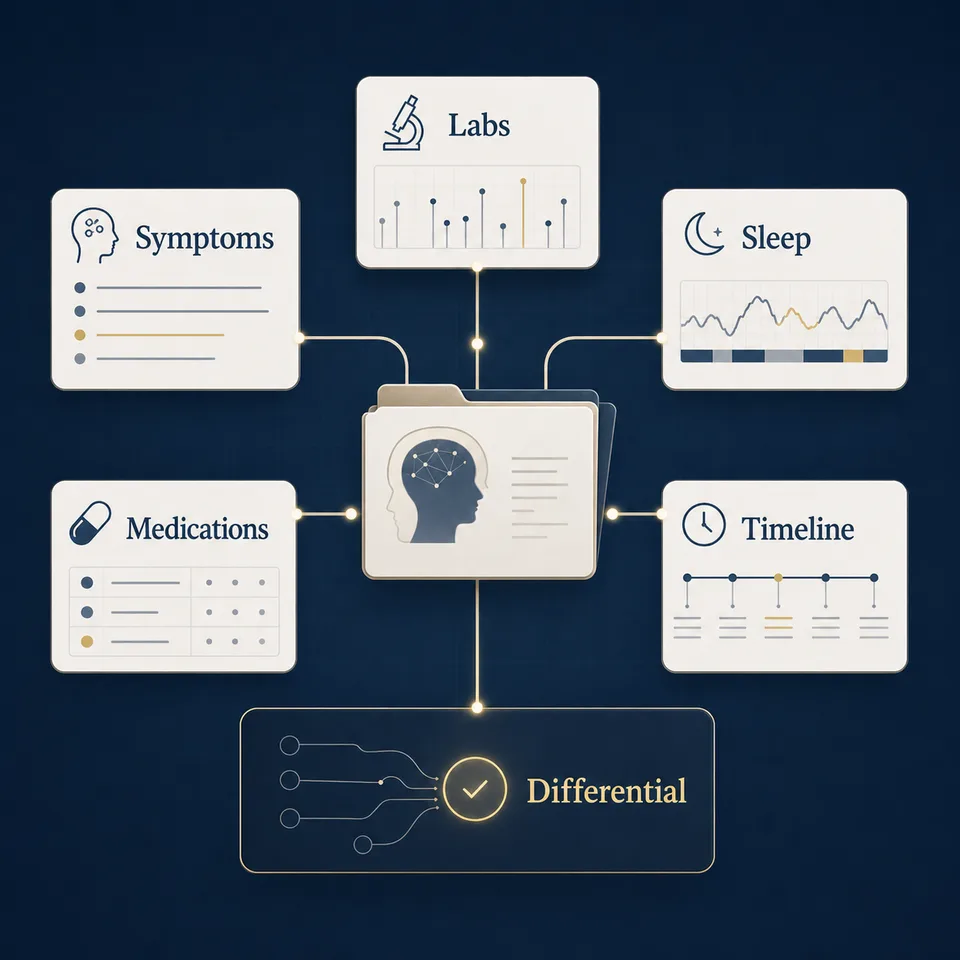
Visual frame
Severity is not the same as cause.
A high score tells you the burden is real. It does not tell you whether the pattern is primary psychiatric illness, sleep disruption, medication effect, medical mimic, psychological stress, or more than one at once.
Review frame
What belongs beside symptom scores
Inputs
- PHQ-9 and GAD-7
- Insomnia and sleep schedule
- Medication and supplement timeline
- Thyroid, ferritin, B12/MMA, glucose when clinically relevant
- Caffeine, alcohol, cannabis, nicotine, stimulant pattern
- Onset, course, function, risk, and prior response
Output
- Symptom and timeline summary
- Lab-pattern read in psychiatric context
- Medication, supplement, sleep, and substance review
- Psychiatric-medical differential
- Named pathway for care or monitoring
Not this
- Not emergency care
- Not a diagnosis from labs
- Not a medication or supplement change by website
- Not a replacement for primary care, psychiatry, or therapy
- Not proof that biology explains every symptom
What scores do well
A score makes symptom burden visible.
PHQ-9 and GAD-7 can help track depression and anxiety symptoms over time, communicate severity, and monitor response. They are useful because they standardize part of the story.
What scores miss
They do not tell you what else belongs in the room.
The body can present psychiatrically
Thyroid disease, iron deficiency, B12 deficiency, glucose swings, sleep apnea, endocrine changes, and inflammatory illness can mimic or amplify psychiatric symptoms when the pattern fits.
Treatment can change the picture
Antidepressants, stimulants, sedatives, antipsychotics, hormones, supplements, caffeine, alcohol, and cannabis can affect sleep, mood, energy, and cognition.
Timing often carries the clue
A score does not show whether symptoms followed childbirth, infection, medication change, sleep collapse, substance change, trauma, grief, or a medical event.
Diagnostic Psychiatry difference
The score stays useful because it is no longer asked to do every job.
- Use PHQ-9 and GAD-7 to quantify symptom burden.
- Use labs and medical history to test whether a contributor may fit the pattern.
- Use medication and sleep history to avoid mislabeling side effects or sleep disruption as primary illness.
- Use clinical judgment to decide what should be treated, referred, monitored, or left alone.
Safety boundary
The review does not turn signals into certainty.
- High scores, suicidal thoughts, self-harm risk, mania, psychosis, withdrawal, or rapidly worsening symptoms require urgent clinical evaluation.
- Labs are signals, not diagnoses.
- This does not replace primary care, emergency care, psychiatric care, or therapy.
- Medication and supplement changes require clinician guidance.
- Urgent findings belong with the appropriate medical or emergency pathway.
- Sometimes the honest conclusion is that no medical change is needed.
Common questions
Questions people ask before they start.
Can PHQ-9 and GAD-7 scores diagnose the problem?
No. PHQ-9 and GAD-7 scores can change what belongs in the differential. A responsible review still requires clinical history, symptoms, timing, medication context, risk review, and the appropriate clinician relationship.
What does the review actually give me?
A written psychiatric-medical synthesis: what appears more likely, what remains possible, what seems less likely, what needs another clinician, and what should be monitored or left alone.
Is this emergency care?
No. If symptoms are acute, dangerous, rapidly worsening, or involve possible self-harm, psychosis, mania, delirium, withdrawal, chest pain, neurologic symptoms, or medical instability, use emergency or urgent care.