Service
Diagnostic Psychiatry Review
A structured synthesis of labs, symptoms, medications, sleep, screening scores, substances, supplements, and timeline to clarify what may be medical, psychiatric, sleep-related, medication-related, psychological, or mixed.
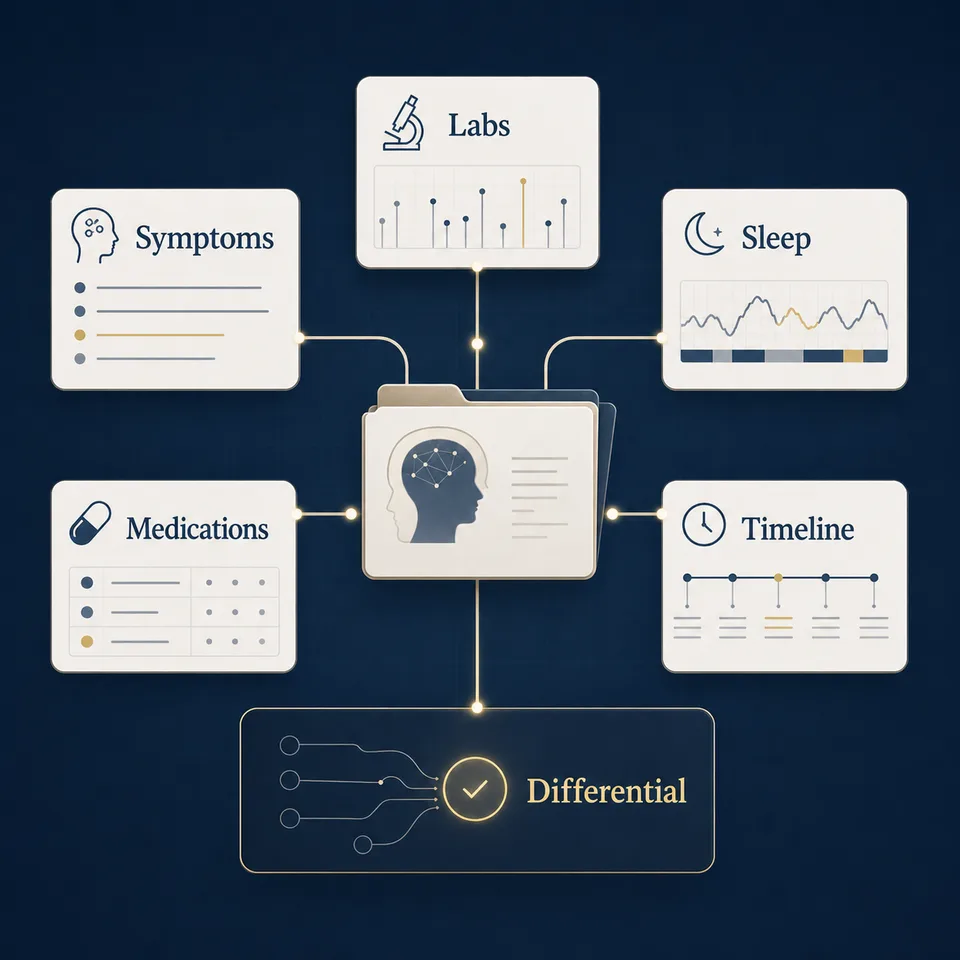
Visual frame
The product is the synthesis.
The review does not chase every abnormality. It organizes the available record so the psychiatric presentation can be read in medical context and routed responsibly.
Review frame
What comes into the Diagnostic Psychiatry Review
Inputs
- Labs
- PHQ-9 and GAD-7
- Insomnia screen
- Medication and supplement list
- Sleep, caffeine, alcohol, and substance pattern
- Symptom timeline
- Top goals
Output
- Symptom and timeline summary
- Lab-pattern read in psychiatric context
- Medication, supplement, sleep, and substance review
- Psychiatric-medical differential
- Named pathway for care or monitoring
Not this
- Not emergency care
- Not a diagnosis from labs
- Not a medication or supplement change by website
- Not a replacement for primary care, psychiatry, or therapy
- Not proof that biology explains every symptom
Adaptive intake
Start with the symptom. Let the next questions open from there.
The review should not feel like one long questionnaire. A positive symptom, safety concern, medication issue, or lab pattern should immediately open the next relevant assessment lane while the story is still fresh.
Is this depression, mixed mood, grief, medication effect, sleep collapse, medical drag, or an urgent safety pathway?
Positive anchors
- PHQ-9 severity and item 9 safety screen
- Anhedonia, hopelessness, function change, irritability, or emotional flattening
- Mania, psychosis, self-harm, substance withdrawal, or rapidly worsening symptoms
Triggered workup
- Mood and safety triage opens immediately
- Sleep, substance, medication, thyroid, iron, B12, and inflammation prompts become visible
- Urgent-care routing replaces routine review when safety criteria are present
Staff prep
- Collect current medications, prior trials, dose changes, and adverse effects
- Ask for recent labs and hospitalization or crisis history when relevant
- Flag same-day clinician review if safety criteria are positive
Clinical read
Diagnostic Psychiatry Review is a review product, not a lab-score reaction.
The whole pattern
Labs, PHQ-9, GAD-7, insomnia screen, medication list, supplements, sleep, substances, timeline, and goals are reviewed together.
A clinical differential
The result is not a lab diagnosis. It is a written read of what may be medical, psychiatric, sleep-related, medication-related, psychological, or mixed.
The next clinical move
Each concern is routed toward psychiatric care, primary care, specialty care, further testing, monitoring, or no medical action.
Process
The work is simple to explain and hard to fake.
- Bring the relevant records and symptom timeline.
- Anchor symptoms with screening tools instead of memory alone.
- Read labs beside sleep, medications, substances, medical history, and psychiatric presentation.
- Separate what is likely, what is possible, what is unlikely, and what needs another clinician.
What to bring
The review works better when the record is complete.
- Labs
- PHQ-9 and GAD-7
- Insomnia screen
- Medication and supplement list
- Sleep, caffeine, alcohol, and substance pattern
- Symptom timeline
- Top goals
What you receive
A written differential and a named next step.
- A symptom and timeline summary that can be read in one sitting.
- A lab-pattern read in psychiatric context, not in isolation.
- A medication, supplement, sleep, and substance-context review.
- A psychiatric-medical differential with what is more likely, less likely, and still uncertain.
- A pathway: psychiatric care, primary care, specialty referral, further testing, monitoring, or no medical action.
Safety boundary
The review does not turn signals into certainty.
- Clinical services are available only where scope, licensure, and the appropriate clinician relationship are established.
- Reading this page does not create a clinician-patient relationship.
- Labs are signals, not diagnoses.
- This does not replace primary care, emergency care, psychiatric care, or therapy.
- Medication and supplement changes require clinician guidance.
- Urgent findings belong with the appropriate medical or emergency pathway.
- Sometimes the honest conclusion is that no medical change is needed.
Common questions
Questions people ask before they start.
Is the Diagnostic Psychiatry Review a diagnosis?
No. The review organizes the differential and names responsible next steps. Diagnosis, medication decisions, controlled-substance prescribing, and treatment changes require the right clinician-patient relationship.
What records make the review stronger?
Recent labs, prior medication trials, current medications and supplements, sleep pattern, substance and caffeine pattern, symptom timeline, and any relevant screening scores.
Can the answer be that no medical action is needed?
Yes. A serious review should be able to say when a finding does not explain the symptoms or when psychiatric care remains the best next lane.